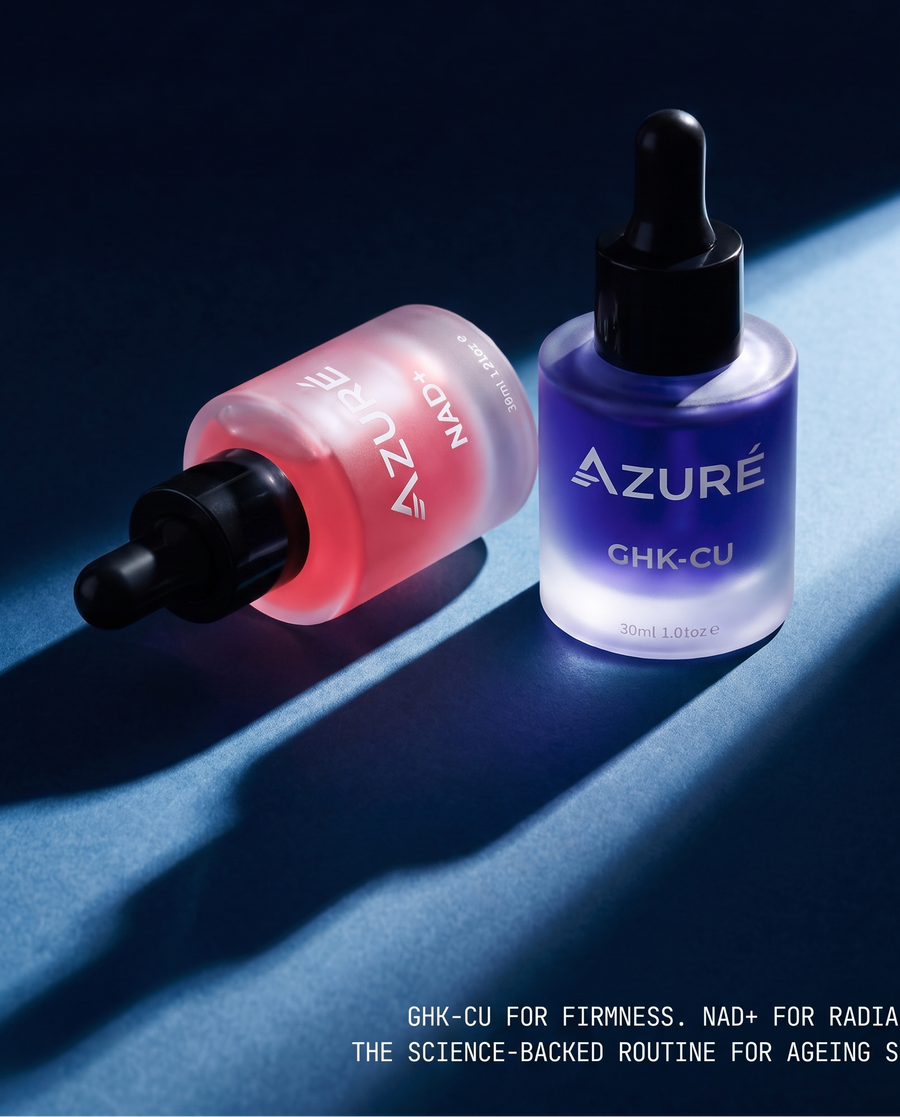
Copper peptides are one of the few skincare ingredients with a research history measured in decades rather than product cycles. Here's what they are and why the concentration on the label matters more than most people realise.
What GHK-Cu actually is
GHK-Cu is a copper peptide — a short chain of three amino acids (glycine, histidine, lysine) bound to a copper ion.
It was first identified in human blood plasma in 1973, not in a lab looking for a skincare ingredient. Researchers studying why older plasma behaved differently from younger plasma isolated the molecule and found it had a role in tissue repair. That's the origin: a naturally occurring peptide in the human body, discovered by accident.
The finding that made it interesting for skin came later. GHK-Cu levels in the body decline substantially with age — the sharpest fall happens between your twenties and your sixties, which maps closely onto the period when skin loses firmness and repairs more slowly.
How copper peptides work
Copper is not incidental here. It's a required cofactor for several enzymes involved in building and cross-linking collagen and elastin — the proteins that give skin its structure and its bounce back.
The trouble is that free copper isn't something you want to apply to skin. It's reactive and poorly absorbed. The peptide solves both problems: it binds the copper, carries it through the skin's outer layer, and delivers it where the enzymatic machinery can use it.
This is what makes GHK-Cu a carrier peptide rather than a signal peptide. It isn't only instructing the skin — it's supplying something the skin needs to carry the instruction out.
What the research supports
Loren Pickart, who first isolated the molecule, has published on it continuously since the 1970s, latterly with Anna Margolina. Two review papers cover most of what's established:
The areas with the most support are collagen production, skin firmness and elasticity, the appearance of fine lines, and the appearance of photodamage and uneven pigmentation.
Worth being precise about what that means. This is a body of research supporting a mechanism and a direction of effect — not a guarantee of a particular result on a particular face in a particular timeframe. Anyone promising you that is selling, not citing.
Why concentration is the whole argument
Here is the part the industry is quiet about.
Most copper peptide products on the market are formulated at around 0.1%. At that level the ingredient is real, present, and legitimately listed — but it's doing very little. It's there so the marketing can say it's there.
Azuré's serum is formulated at 3% GHK-Cu. That's roughly thirty times the typical concentration.
The practical takeaway isn't brand-specific: when you're comparing copper peptide products, the percentage is the only number that tells you anything. A product that doesn't state its concentration has usually made that choice deliberately.
How to use copper peptides
Apply to clean, damp skin. Peptides work best with nothing between them and the surface, so they go on before creams, oils and SPF.
Once or twice daily, consistently. This is not an ingredient that rewards intensity. It rewards not skipping.
Don't layer with vitamin C. Most vitamin C serums are formulated at a low pH that can destabilise the copper complex. Split them across the day — vitamin C in the morning, copper peptides at night.
Go carefully alongside strong exfoliating acids for the same reason. Alternate nights rather than stacking.
Give it eight to twelve weeks. Collagen remodelling runs on the skin's timeline, not yours. Early changes tend to show up as texture and hydration; firmness takes longer.
Who it suits
Copper peptides are unusually gentle for an active. They don't typically cause the peeling, purging or sun sensitivity that comes with retinoids, which makes them a realistic option for sensitive skin, for anyone whose barrier is already struggling, and for people who've tried retinol and couldn't tolerate it.
They also pair well with microneedling. A derma stamp creates temporary micro-channels that let a serum travel past the surface barrier — though apply once the skin has settled rather than immediately after.