Plenty of women describe the same thing: skin that behaved predictably for decades starts behaving differently, fairly quickly, somewhere around their late forties or early fifties. It isn't imagination, and it isn't simply age arriving on schedule.
What's actually happening
Oestrogen does considerably more for skin than it gets credit for. It supports collagen production, helps maintain skin thickness, influences how much moisture the skin holds, and plays a part in oil production and wound healing.
As oestrogen falls through perimenopause and menopause, all of those are affected at once. That's why the change often feels abrupt rather than gradual — it isn't one process slowing down, it's several shifting together.
Collagen loss is the part with the most visible consequences. The decline is steepest in the years immediately around menopause, then settles to a slower ongoing rate. Which is why this period tends to feel like a step change rather than a slope.
What you might notice
Dryness, and a different kind of it. Not tightness after cleansing that a moisturiser fixes, but a persistent dryness that doesn't fully resolve. Reduced oil production and a less efficient barrier both contribute.
Loss of firmness. Skin that recovers more slowly when pressed, and looks less supported along the jaw and cheeks.
Thinner, more fragile skin. More visible blood vessels, easier bruising, cuts that take longer to heal.
More reactivity. Products used comfortably for years may start to sting. A weakened barrier lets more through, and reacts to more.
Adult breakouts. Counterintuitive alongside dryness, but the shifting ratio between oestrogen and androgens can trigger congestion, often along the jawline.
Uneven tone. Existing pigmentation can become more pronounced, and sun damage accumulated decades earlier tends to surface now.
Not everyone gets all of these, and the timeline varies widely. But if several arrived together, that's the pattern.
What helps
Protect the barrier first. This is the step people skip in favour of actives, and it's backwards. If your skin is dry, reactive and stinging, no serum will perform well on it. Gentler cleansers, richer moisturisers, less frequent exfoliation. Get comfortable before you get ambitious.
Reconsider what you were using. A routine that suited you at forty may be too harsh now. Strong acids and high-strength retinoids often need dialling back — not necessarily abandoned, but used less often.
Support collagen where you can. Since the underlying change is structural, ingredients that work on collagen production are the logical response. Retinoids have the deepest evidence base but are frequently poorly tolerated at this point. Peptides are the gentler route — they support the skin's own collagen production without the peeling or sensitivity, which matters when your barrier is already compromised.
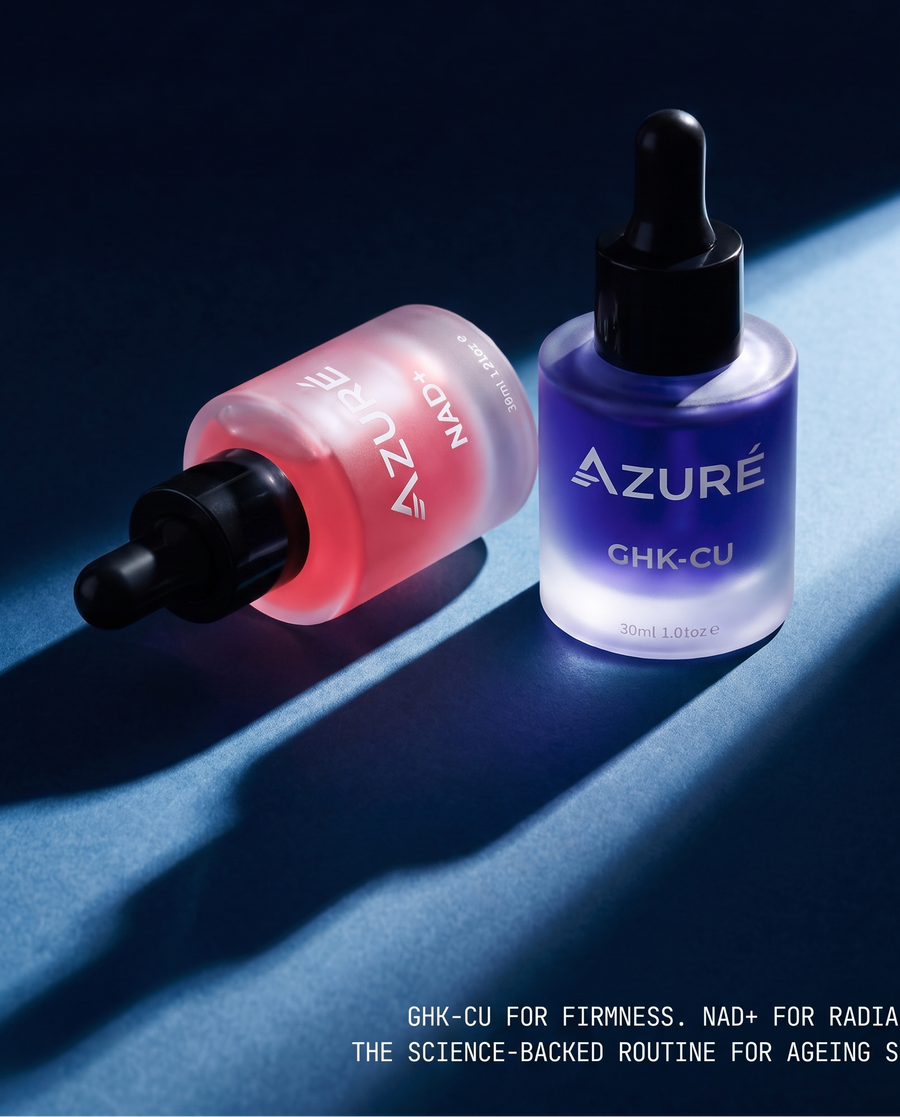
Copper peptides such as GHK-Cu are the most-researched group here, with published work spanning fifty years covering collagen production, firmness, elasticity and the appearance of photodamage (PMC4508379, PMC6073405).
Keep up the sunscreen. Thinner skin is more vulnerable, not less. This does not become optional.
Be realistic about the timeline. Eight to twelve weeks minimum before assessing anything. This is a period where skincare marketing gets particularly aggressive and particularly vague, and where a lot of money gets spent on very little.
Worth raising with a doctor
Skincare works on the appearance of skin. It doesn't address the hormonal change underneath it.
If menopausal symptoms are affecting your quality of life — skin among them, or alongside sleep, mood, temperature regulation or anything else — that's a conversation for your GP or a menopause specialist. Systemic options exist, they're a genuine medical decision with genuine trade-offs, and they're outside what any serum can speak to.
Both things can be true: a good routine is worth having, and it isn't the whole picture.