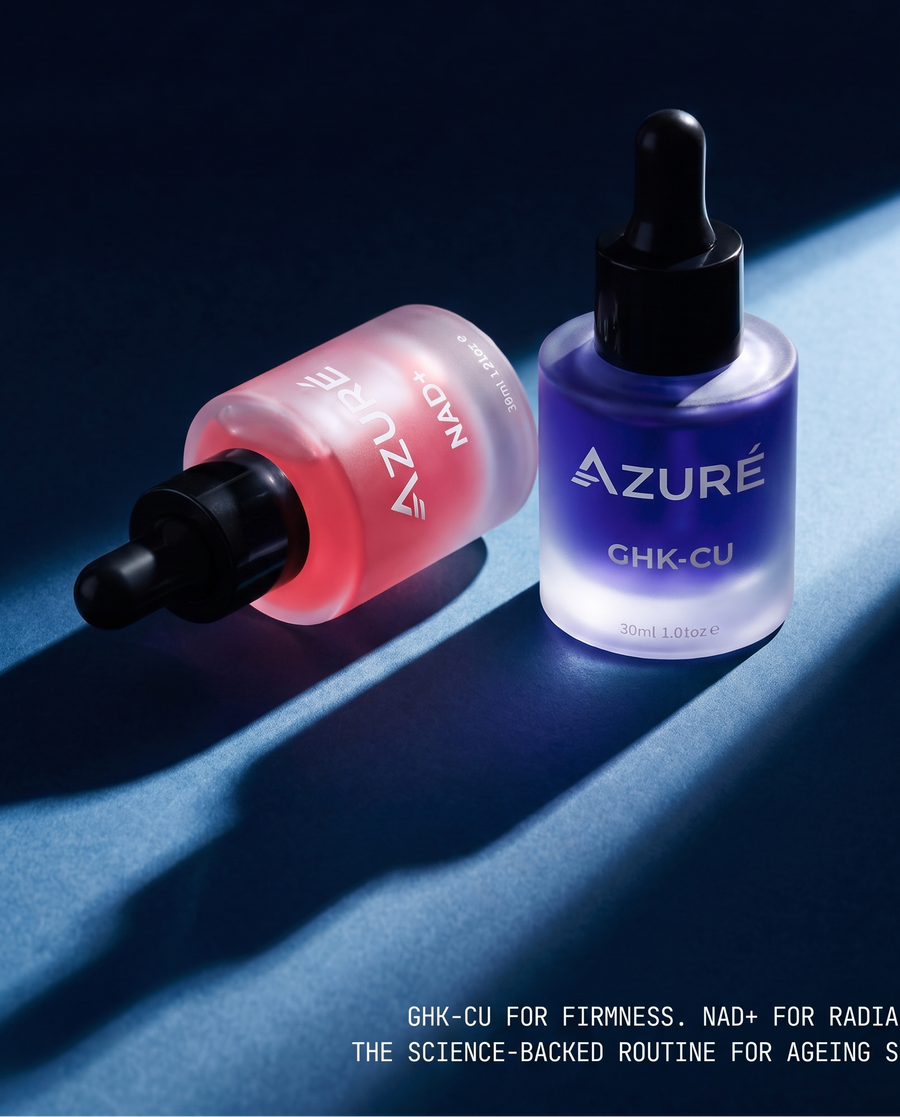
Peptides turn up on almost every serum label now, usually with very little explanation attached. Here's what they actually are, what they do, and where the evidence is stronger or weaker.
What a peptide is
Proteins are long chains of amino acids. A peptide is a short one — usually somewhere between two and fifty amino acids, where a protein might run to hundreds.
That length difference matters more than it sounds. Collagen is a protein, and it's far too large to pass through the outer layer of skin. This is why collagen creams have always been a slightly awkward proposition: the molecule sits on the surface rather than reaching the layer where collagen is actually built.
Peptides are small enough to be a different proposition. And rather than acting as raw material, they tend to act as messengers.
Peptides work by signalling, not supplying
The useful way to think about a peptide is as an instruction rather than an ingredient.
Your skin is constantly breaking down and rebuilding its own structural proteins. When collagen fragments during that process, the fragments themselves act as signals — the skin reads them as evidence of damage and responds by producing more. Certain peptides mimic those signals. Applied topically, they can prompt the same repair behaviour without any actual damage having occurred.
That's the mechanism behind most peptide skincare: not adding collagen to the skin, but encouraging the skin to make its own.
The four types you'll encounter
Peptides aren't one ingredient, and the category is broad enough that two "peptide serums" can do quite different things.
Signal peptides are the most common in anti-ageing formulas. They communicate with skin cells to support collagen and elastin production. Matrixyl (palmitoyl pentapeptide) is the best-known example.
Carrier peptides transport trace minerals — usually copper — into the skin, where those minerals are needed for enzymatic processes involved in wound healing and tissue remodelling. GHK-Cu is the defining example, and the one with the longest research history.
Enzyme-inhibiting peptides work by slowing the enzymes that break existing collagen down. A different approach to the same goal: rather than building more, preserve what's there.
Neurotransmitter-inhibiting peptides — argireline is the common one — aim to reduce the muscle contraction that creates expression lines. This is the category most prone to overclaiming, and the one where topical evidence is thinnest.
What the evidence supports
Peptide research is genuinely uneven, and it's worth being clear about that.
The strongest body of work sits with GHK-Cu, a copper peptide first identified in human plasma in 1973. Loren Pickart and colleagues have published on it for five decades, with reviews covering its role in skin remodelling, collagen production and the appearance of photodamage (PMC4508379, PMC6073405).
Elsewhere the picture is patchier. Many peptides have promising laboratory data and comparatively little independent human testing. Plenty of products list a peptide at a concentration far too low to plausibly do anything — the ingredient earns its place on the label rather than in the formula.
Two questions cut through most of it: which peptide, and at what concentration.
What peptides realistically do
Used consistently, peptides can help support firmness, elasticity and the appearance of fine lines. They're a slow-acting category — you're influencing a process that runs on the skin's own timeline, so results build over weeks and months rather than days.
They're also unusually well tolerated. Unlike retinoids or acids, peptides don't typically cause peeling, purging or sun sensitivity, which makes them workable for people whose skin doesn't get on with stronger actives.
How to use them
Apply peptide serums to clean, slightly damp skin before heavier creams and oils, so nothing blocks them from reaching the surface.
One pairing to avoid: don't layer copper peptides and vitamin C in the same application. The low pH of most vitamin C serums can destabilise the copper complex, and each may work against the other. Use them at opposite ends of the day — vitamin C in the morning, peptides at night — and both stay intact.
Give any peptide product at least eight to twelve weeks before deciding whether it's working. Anything promising a visible change in days is describing hydration, not collagen.